

Swanwick Colliery, Swanwick
by SLHS on
Monday 2 May 2016
After the death of Charles Turner of Swanwick in 1736 without an heir, his estate was to be divided equally between relatives of his mother, as mentioned in his Last Will & Testament, but only after her death and then to be held in trust for a period of 99 years. The executors of his Will formed the Swanwick Coal Co. as part of the estate.
After the Enclosure Act the Palmer-Morewood family started to mine on what was then called Alfreton Common. Both RCA Palmer-Morewood and the Swanwick Colliery Co sank several shafts in the area around what would become the Swanwick Colliery complex.
From various sources, the dates (in some cases approximate) for the various shafts can be determined as below:
- Swanwick Engine – first sunk in 1833
- Swanwick Old – first sunk in 1851 to the Top Hard Seam
- White’s Lane – first sunk in 1853 to the Waterloo Seam, and then extended in 1867 to the Deep Hard Seam.
- Swanwick Deep – first sunk in 1856 to the Top Hard Seam and then extended in 1867 down to the Deep Hard Seam
- Swanwick Common – first sunk in 1903 to the Waterloo Seam
- Swanwick New - first sunk in 1914 and went through all of the seams down to 50 metres below Black Shale. The Black Shale Seam was mined at a depth of approximately 359 metres. This seam was mined until 1968, when Swanwick Colliery closed.
The coal exploited at Swanwick was considered to be of the very best quality. White’s Directory of 1857 states “…About 1 mile S.E. of Alfreton lies the Swanwick Colliery, the property of William Palmer Morewood, Esq. The superior quality of this coal has induced a number of persons to vend a very inferior article in its name, in places where it has never been introduced. The seam is about five feet in thickness, and is raised to the surface by a small engine of eight horses’ power. The works are kept dry by an engine of forty horses’ power, which is also assisted in very wet weather by a smaller one. The coal is conveyed by railway first to the summit of an inclined plane, by means of a small engine of eight horses’ power, the waggons being attached to a wire rope, about 400 yards long. On the summit is a wharf for the sale of coal, near to which is the Alfreton Old Poorhouse, converted into cottages since the New Poor Law came into operation. The situation of the wharf and poorhouse is called Sleet Moor, and about fifty years ago it was a wide common which was used as a race course.” . Refer also to the Article titled "Swanwick & Somercotes Coals - Newspaper Notice of 1806 ", in this section.
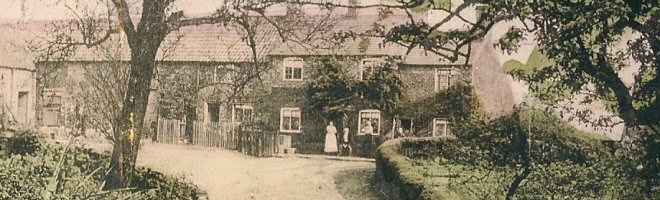
The “Alfreton Old Poor House” referred to in White’s Directory was last converted to the Laburnum Inn, on Sleetmoor Lane, which itself was demolished in the early 1960s.
In 1947, Swanwick Colliery was nationalised and became part of the National Coal Board. It continued to mine the Black Shale seam until it was finally closed in 1968.
The last Colliery Manager was Mr. Ernest Hopkins.